

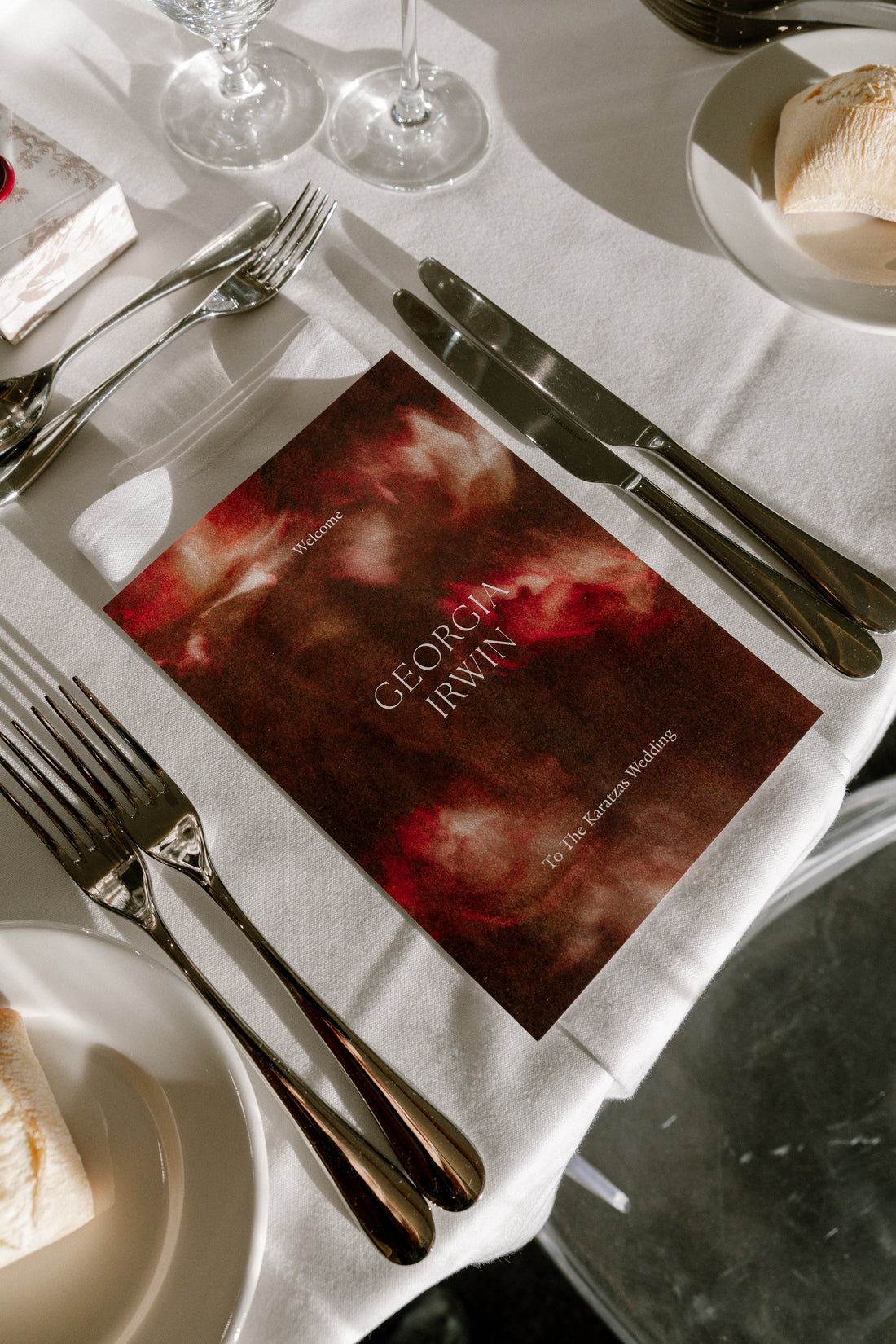
A wedding menu card is a small piece of paper doing a surprising amount of work. It tells your guests what is coming, sets the tone for the meal, and quietly ties the reception table back to your invitation. Get the wedding menu wording right and it feels effortless; get it muddled and guests are left squinting at the table trying to work out whether there is a choice. This is a course-by-course guide to wording your menu beautifully — with examples designed to sit within a Just Hitched menu card and the way our suites are laid out.
What to include on a wedding menu card
Before the wording, the shape. A Just Hitched menu follows a consistent, editorial structure that you can lean on:
- A heading — on our designs this is a soft script The Menu, the same script used across your suite.
- Your names or monogram, usually as a small detail at the base of the card.
- The courses, listed in the order they are served, each under a spaced serif heading.
- A note on how each course is served — alternating, roaming or a choice.
- A single dietary line, so guests know their requests have been accounted for.
You do not need every element. The most elegant menus are often the sparest — a heading, three courses, a monogram. If you are still mapping out which pieces your reception tables need, our guide to stationery suite essentials is a good place to start.
How to word each course
A quick note on language: in Australia the entrée is the first course, followed by the main, then dessert. On a Just Hitched menu, each course sits under a spaced serif heading in capitals, with the dish written simply beneath it. The trick is restraint — name the dish, add a few defining words, and stop.
Entrée
Keep the first course light on the page as well as the plate. Lead with the hero ingredient, then two or three supporting notes.
ENTRÉE
Heirloom tomato and burrata, basil oil, sourdough
If there is a choice, our menus note it clearly so no one is left guessing:
ENTRÉE (ALTERNATING)
Twice-baked cheese soufflé / Cured kingfish, finger lime, cucumber
Main
The main is where guests linger longest, so a little more description earns its place — the protein, the way it is cooked, and one or two sides.
MAIN
Herb-crusted chicken breast, roasted garlic mash, broccolini, jus
MAIN (ALTERNATING)
Seared ocean trout, charred asparagus, lemon butter / Slow-braised beef cheek, potato purée, red wine
Dessert
Dessert can be the most playful line on the card. If it is served grazing-style or as a roaming platter, say so — it tells guests to expect something shared rather than plated.
DESSERT (ROAMING)
Warm chocolate fondant, vanilla bean ice cream · Lemon tart, torched meringue
Alternating or roaming: how to note your service style
How your caterer serves each course changes the wording, and it is the detail guests most often miss. A few conventions our menus use:
- Alternating (sometimes called alternating drop) — two dishes are served alternately around the table. Note it beside the course heading, as in ENTRÉE (ALTERNATING), and list both dishes separated by a slash.
- Roaming or grazing — food is shared or passed rather than plated. Marking a course as roaming tells guests to expect something relaxed and communal.
- Pre-selected choice — if guests chose their main when they replied, add a gentle line such as: Please see your place card for your selection. This pairs naturally with your name cards.
Where guests recorded a choice or a dietary need on their reply card, it is worth keeping your menu and your finer details card speaking the same language, so the wording lines up from the RSVP through to the table.
Wording a drinks or bar menu
A drinks menu is a lovely, low-effort way to make the bar feel considered, and it follows the same restrained style. Group by type and keep each line short. Our drinks menus and bar menus are designed to match the rest of your suite.
ON ARRIVAL
Sparkling · Aperol spritz
WINE
Adelaide Hills chardonnay · Coonawarra shiraz
SIGNATURE
The couple’s negroni
NON-ALCOHOLIC
Seasonal spritz · Sparkling water
A single signature cocktail named after the two of you is a small touch guests always remember.
Matching the wording to your collection
The words should feel like the design they sit on. Because every Just Hitched menu belongs to a collection, let the collection’s personality guide your tone:
- Heritage and Classic — formal and precise. Spaced serif capitals, full dish descriptions, minimal flourish.
- Elegance and Romance — soft and romantic. Let the script do the talking and keep descriptions short and lyrical.
- Whimsical — relaxed and warm. A lighter, more conversational turn of phrase suits the garden-romance feel.
Whichever you choose, every piece is printed on premium 350gsm Knight Smooth card stock and designed to pair across your whole suite. You can see how it all comes together on our How It Works page.
Menu wording templates to adapt
Three simple frameworks to make your own — swap in your dishes and service style.
Plated, three courses
THE MENU
ENTRÉE — [dish, key components]
MAIN — [protein, cooking style, sides]
DESSERT — [dish, accompaniment]
Alternating drop
ENTRÉE (ALTERNATING) — [dish one] / [dish two]
MAIN (ALTERNATING) — [dish one] / [dish two]
DESSERT — [dish]
Grazing / shared
TO SHARE — [selection of dishes, served roaming]
DESSERT (ROAMING) — [selection]
Frequently asked questions
What should a wedding menu card say?
At its simplest: a heading, each course in the order it is served, a short description of each dish, and a note on how it is served if there is a choice. Your names or monogram at the base and a single dietary line round it out. Anything more is optional.
Do you list dietary requirements on the menu?
You do not list each guest’s requirements on the card itself. Instead, gather them on your reply card and add one reassuring line to the menu, such as: Dietary requirements have been catered for as noted with your caterer. It keeps the design clean while letting guests know they have been looked after.
What is alternating service, and how do you word it?
Alternating (or alternating drop) service means two dishes are served alternately around the table, so neighbours can swap if they prefer. Word it by marking the course heading — for example MAIN (ALTERNATING) — and listing both dishes separated by a slash.
Do you need a menu card for every guest?
Not necessarily. Many couples place one menu per setting for a polished look, but two or three per table, or one shared menu for grazing-style receptions, works beautifully too. Because our menus are made to order, you choose the quantity that suits your tables.
Can the menu match the rest of my stationery?
Yes — that is the whole idea. Every menu is part of a collection, so it pairs with your invitation, finer details, seating chart and name cards. If you would like something entirely your own, our bespoke design service can build a menu around your exact wording and dishes.
Your menu is one of the last details your guests read before the celebration truly begins — so it is worth a few considered words. When you are ready, explore the menu collections to find the one that feels like you.